Notes on a lost online interaction with Cécile B. Evans
31.03.26 | Article by Phillipa Snow | Art, culture, Magazine | MM9 Click to buy
“If we appear to be one thing, well, then, perhaps we are another, and perhaps this deception is, in itself, a lesson about how little it means for something to appear like anything.”
On the internet, nobody knows you’re Philip Seymour Hoffman. Actually, if I might offer one minor correction — on the internet, nobody knows that you aren’t; this is because online, we become the very nebulous thing that all true celebrities are in life: online, we are archetypes, or symbols, or orchestrated-curated projections whose qualities are both like and unlike the qualities of our actual selves. We are ‘bad copies’, where ‘bad’ is used to mean ‘unfaithful’ or ‘inaccurate’ rather than ‘no good’ (I will return to the phrase ‘bad copies,’ later, but in a different context, and with a different meaning). If we appear to be one thing, well, then, perhaps we are another, and perhaps this deception is, in itself, a lesson about how little it means for something to appear like anything; how much of a falsehood appearances are in general. If, as the artist Cécile B. Evans believes, technology has had a greater impact on the value of human emotions within the last few decades than anything other than war, then this redefinition of the possible self as something more flexible is, in some peculiar way, its nuclear fallout. This change is a modern mutation; a glitch; a means of being both visible and invisible to the rest of the world simultaneously, like — to appropriate an image from Evans’ work — the transparent shape of a person, with a visible hairstyle.
There is a reason for the wild convolution of my introduction here, anyway, and the reason is PHIL — that PHIL himself/‘himself’ is the thing that’s intriguing me, but that PHIL is a fairly difficult character for me to render transparent, with or without the attendant hairstyle. He is hard to define except in ways that are very convoluted, and, frankly, I am uncertain of how to begin. What can we say, with any certainty, about PHIL? PHIL is opaque. He is oblique. We can be sure that he is one of the ‘stars’ of Cécile B. Evans’ video artwork, Hyperlinks or it Didn’t Happen; that he is, to some extent, a familiar character, and in others, a frighteningly unfamiliar proposition. He is also a CGI representation of, let’s say for now, a middle-aged Caucasian man. Beyond this is the point where things start to get really interesting: superficially, you or I or anybody who has ever watched a Hollywood movie or read a copy of Esquire or owned a teevee or purchased a newspaper might feel capable of saying, with some authority, that the figure of PHIL is really the figure of Philip Seymour Hoffman — is a cipher, anyway, of Philip Seymour Hoffman, with the same approximate shape and, thus, with the same approximate meaning; that, ipso facto, he must share some larger conceptual link with the actor’s untimely death from an overdose. This is a sane conclusion, but also one which relies too heavily on the use of conventional evidence for this particular situation — while it is true that PHIL admits to being “a digital replacement of a very famous actor,” he never explains which one, exactly; meaning, that aside from his shape and his fully-capitalised first-name and his occupation, he and the Real, mostly-lowercase ‘Phil’ have no definite connection. His creator has no interest, really, in celebrity, and I doubt that PHIL has been instilled with any real idea of what a celebrity or a Philip Seymour Hoffman or an overdose is. Why should he be? He is himself. He’s PHIL. Drawing a line between a dead man and a ghost in the machine has a certain satisfying logic to it, but the logic of technology is not always linear. “I’m not magic,” he sighs, “and please don’t call me uncanny. I’m just a bad copy, made too perfectly, too soon.” ∆ It is useful, if potentially a little tricky, that the word ‘humanity’ has two separate meanings — one (1) “the quality or condition of being human”, and two (2) “the quality or condition of being humane”. If PHIL does not have the quality or condition of being what we might refer to as humane(1), it is certainly possible for us to argue that he is capable of being humane(2); that by extension, he is interesting to us because the idea of an electronic figure possessing this very humane(1) quality feels like a paradox. It’s this very same paradox — namely, the possibility of technology being somehow capable of being tender — that makes what Cécile B. Evans does compelling: when PHIL alludes to the death of a man who may or may not be the one whose shape he apes (“I’m full of him. They say that grief isn’t contagious, but that was just something they told people. When he passed, there was a flood… I will always love him”), he sounds compassionate. When he is frustrated (“FUCK!”), he sounds vaguely unhinged. “They say that something happens when a disaster is captured on film,” he tells the viewer. “People move on, a city rebuilds, of course, but the information is traumatised forever.”
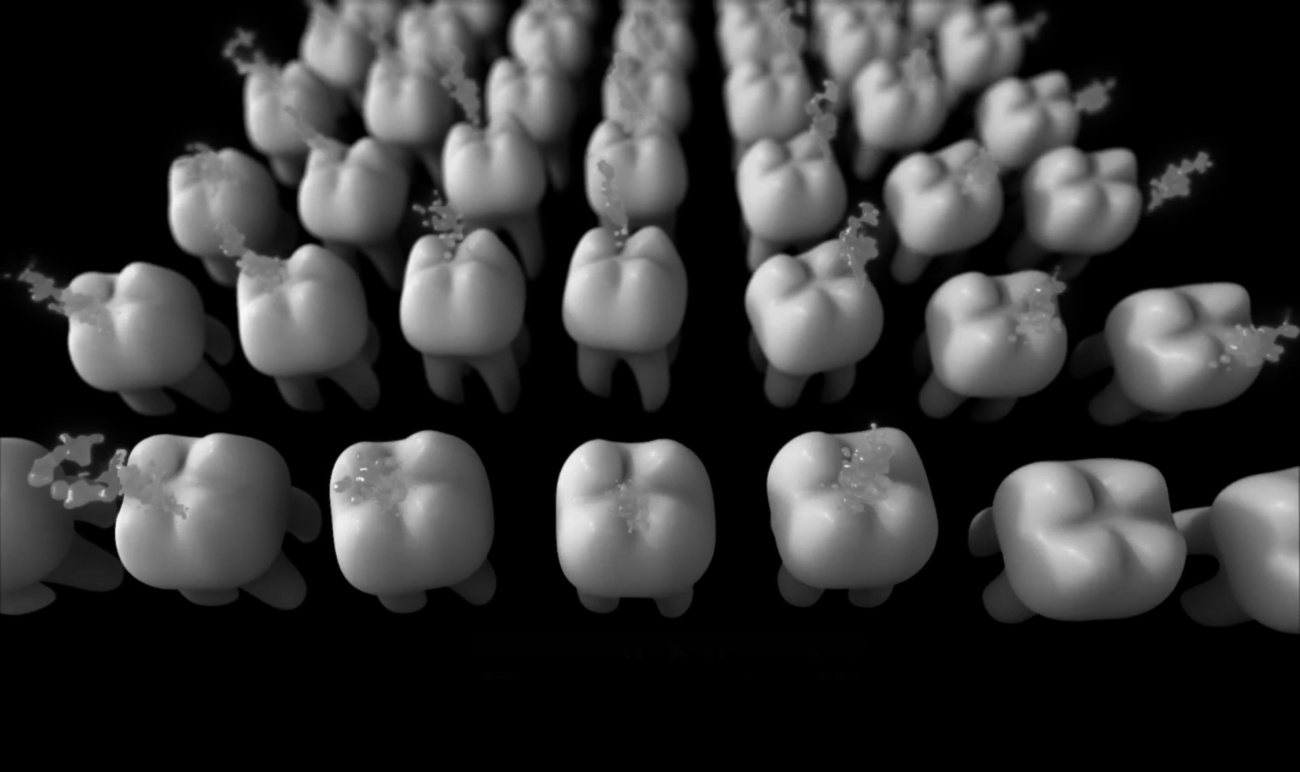
The Brightness, 2013.
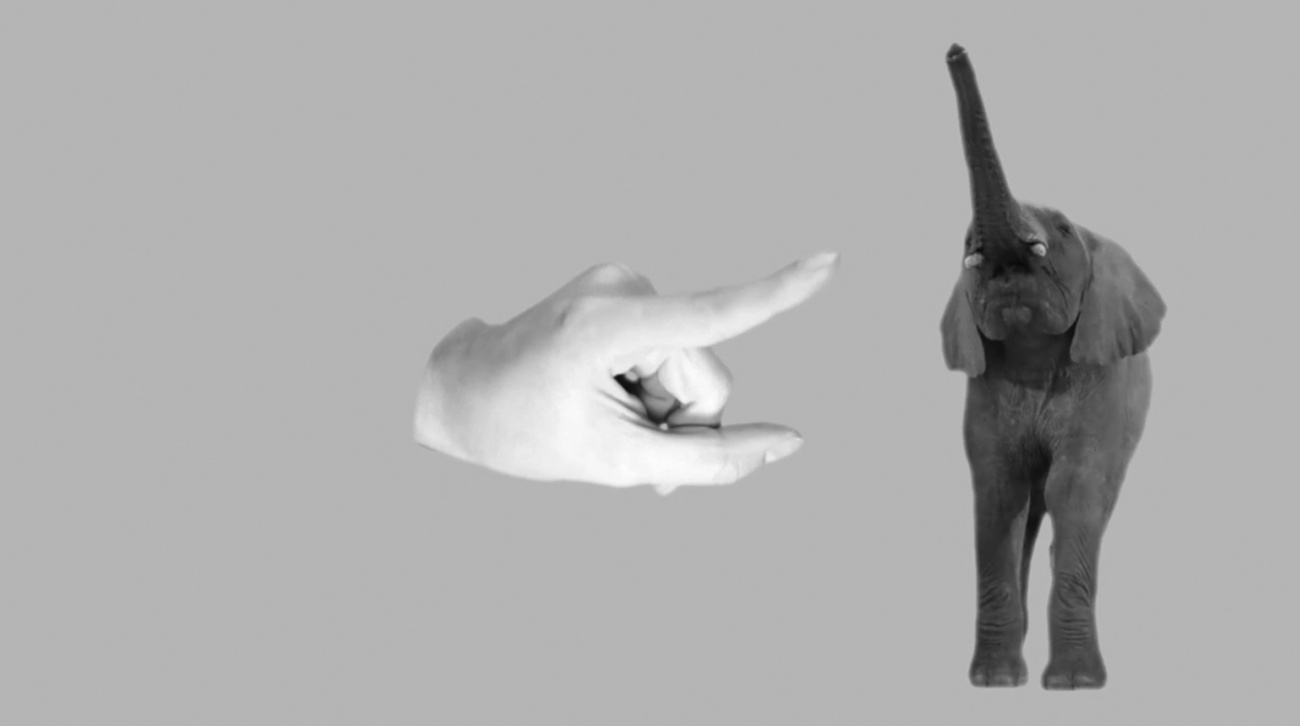
AGNES, Elephant, 2014.
Can electronic information be capable of undergoing trauma? This is a novel proposition; it’s also, given what we now know about the evolution of our fully-emotional, technologically-represented selves, not a wholly unthinkable one. PHIL, we can believe, has agency of some sort — a gift from creator Cécile, who is both humane(1) in her form, and deeply humane(2) in her outlook. He is one of many similar characters, all of whom are beautifully complex: a cartoon pop-star, a mostly-invisible woman, the mostly-invisible woman’s lover, all of them sharing this both unnatural and perfectly natural marriage of melancholy and hi-technology.
I spoke with Cécile B. Evans one afternoon a month or so ago, with the internet as our conduit and with only an avatar (a black-and-white picture, I think, of two people’s dancing feet) as her representative shape; afterwards, I discovered a technological glitch had left me without a recording, demonstrating — depending on how generous your outlook — either the unreliability and ephemerality of the web itself, or my own incompetence in the face of it. My documentation is, thus, unreliable. My own recollections are ‘bad copies’, and my notes are recreations of something more recognisable, and anyway, weren’t made quite soon enough. Still: I know that when Evans was growing up, she says that she remembers hearing it argued that new technology would be a means of problem-solving for society; that, as she grew up further, she found that technology also created new problems; that digital objects are made, these days, to be almost impenetrable to those who haven’t first built them. It is, she says, the same as with any other modern ideology — there is good, and there is bad, the binary extremes of which cannot apply to something as big as the internet in any universal sense. I know that although it might be tempting to see the internet as some huge and unified territory, she, personally, does not: that in her mind, the same restrictions that apply in the physical world still apply in the digital one, and that it is not an egalitarian democracy, but one governed by privilege. Crucially, I also remember her speaking about the idea of all of our live-streamed social media now being mapped out with algorithms; her mentioning one of the big sharing networks — she couldn’t quite recall which one — having recently adopted the mantra: “it will be as if it has always been there”, or something like it. At first, I admit, I found this a sinister prospect; such interventions, though, need not always be inherently frightening for their easy fit into everyday life, and the notion that something new will appear to have always existed in much the same way that it does now is also not intrinsically harmful. Consider PHIL: once you or I have grown accustomed to him, we might be persuaded to believe that he has always existed, too, like a God or a natural phenomenon — that he has a certain inalienable right to a presence, online or off. “I will always be here,” he insists in Hyperlinks…, “lurking somewhere on this drive until they drag me to another, more acclimatised [one]” — unlike the actor for whom he is a ‘digital replacement’, it is certain that PHIL will never die. “I never said” — to use his words — “that this was a linear narrative.” How could it be? Temporality and cycle, for PHIL, are meaningless. “‘What’s the weather like?’ someone will ask me,” he says, before concluding, sadly, that his response to the question will always be: “what’s the weather?” What’s the weather? What’s PHIL? Each one is as hard to explain to the uninitiated as the other. But, either way, it’s as if they have always been there.